
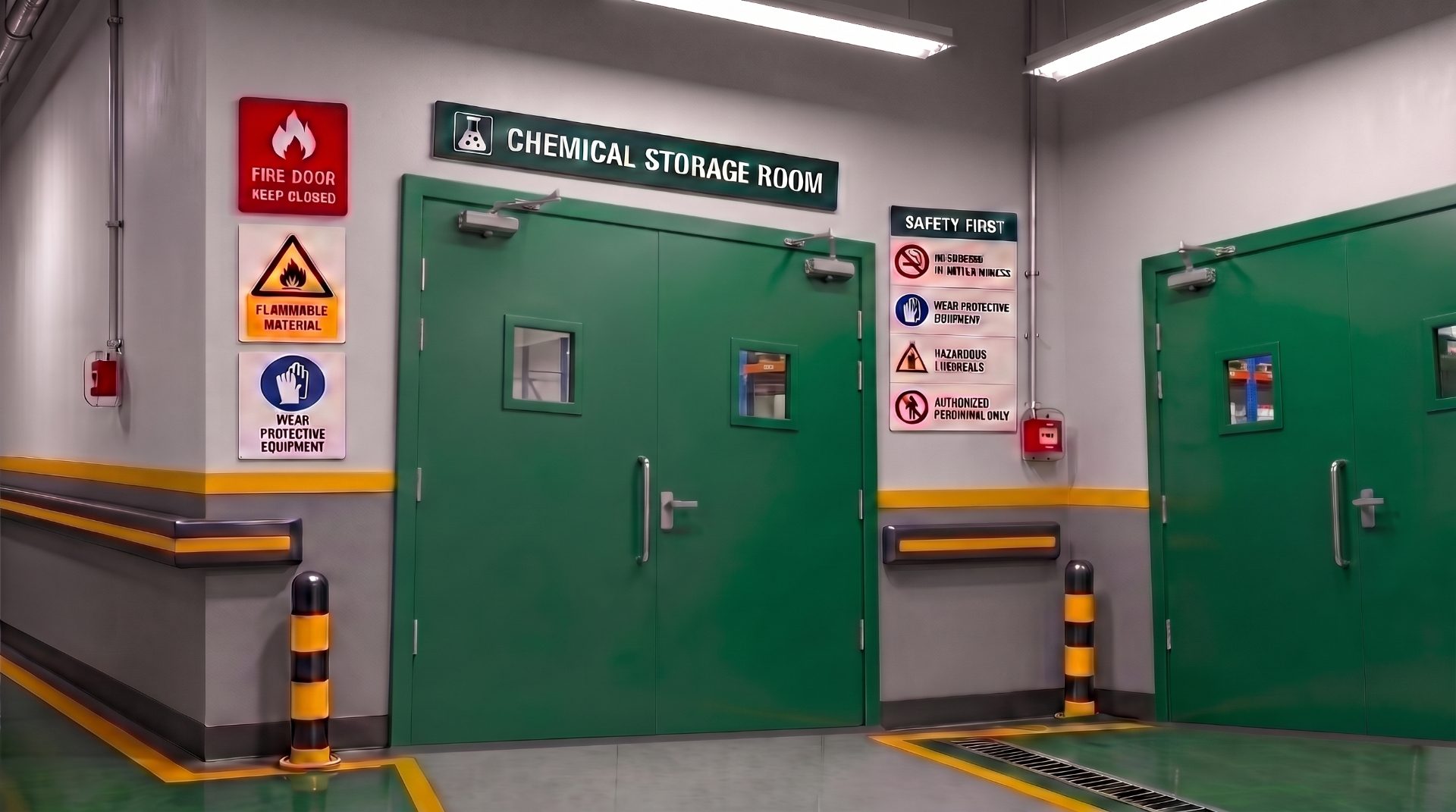
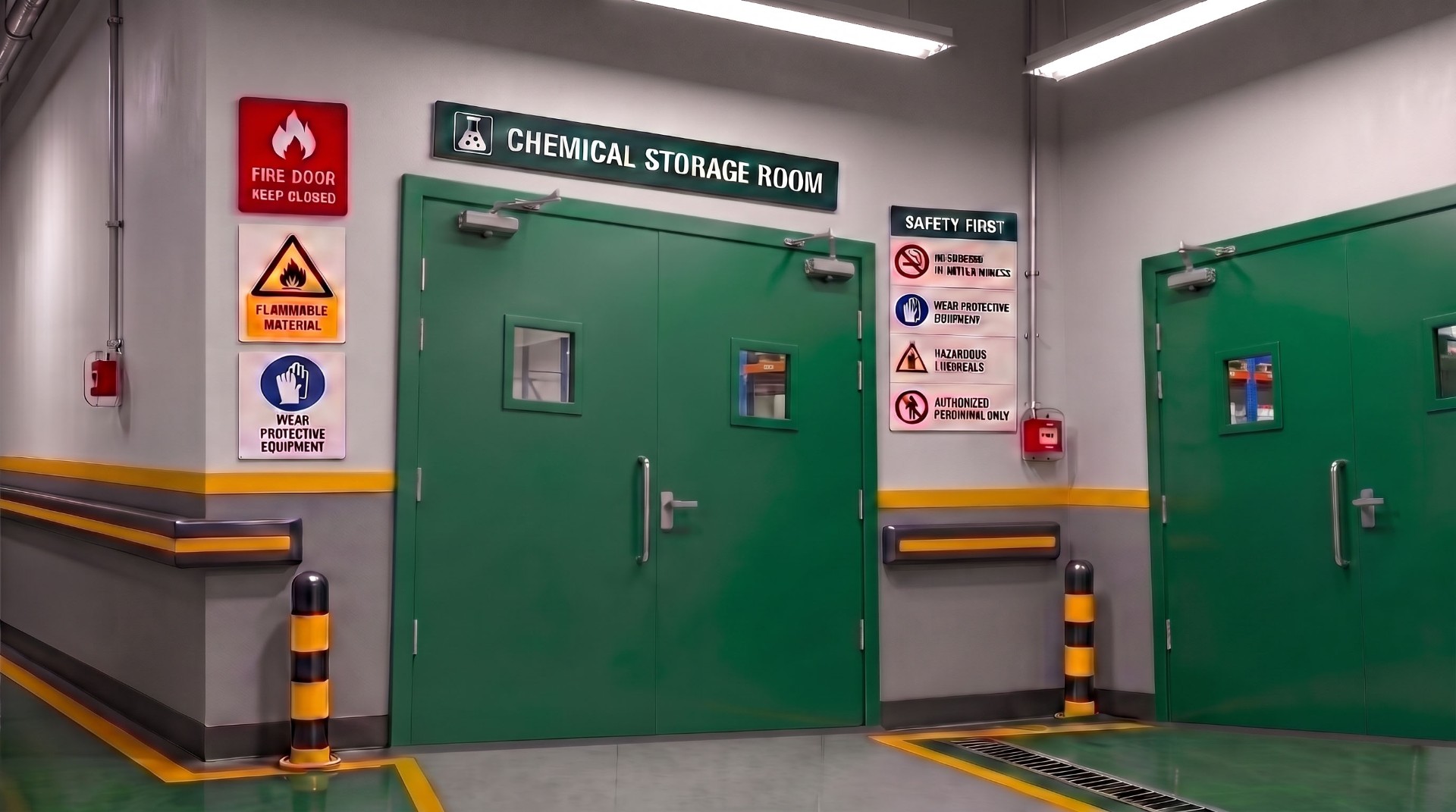
A double leaf fire door is not two single leaf doors sharing a frame. Under IS 3614:2021 it is a distinct configuration, certified on its own test evidence and recorded as its own entry on the manufacturer's BIS licence. What decides whether you need one is the clear width the opening has to deliver, not the look of the leaf.
Almost everything that ranks for this question is written against European or North American hardware practice, where the vocabulary is coordinators, astragals and label stamps. None of that is what an Indian submittal is read against. The Indian position sits in three places: Clause 7.2.5 of IS 3614:2021 and a 2024 decision of the sectional committee that maintains it, Clauses 7.2.6 and 7.2.9 k) on seals and hardware, and the clear width provisions of NBC 2016 Part 4. What follows is each of them, and then the three ways a double leaf doorset fails an inspection a single leaf would have passed.
The opening decides the configuration, not the door
Start with the width the code asks the opening to deliver, because that figure is fixed before any door is selected. NBC 2016 Part 4 sets the floor in Clause 4.4.2.4.1(b): no exit doorway shall be less than 1 000 mm in width, except in assembly buildings, where the door width shall be not less than 2 000 mm. The same sub-clause requires doorways to be not less than 2 000 mm in height, and Clause 4.2.11 repeats the 2.0 m exit door height.
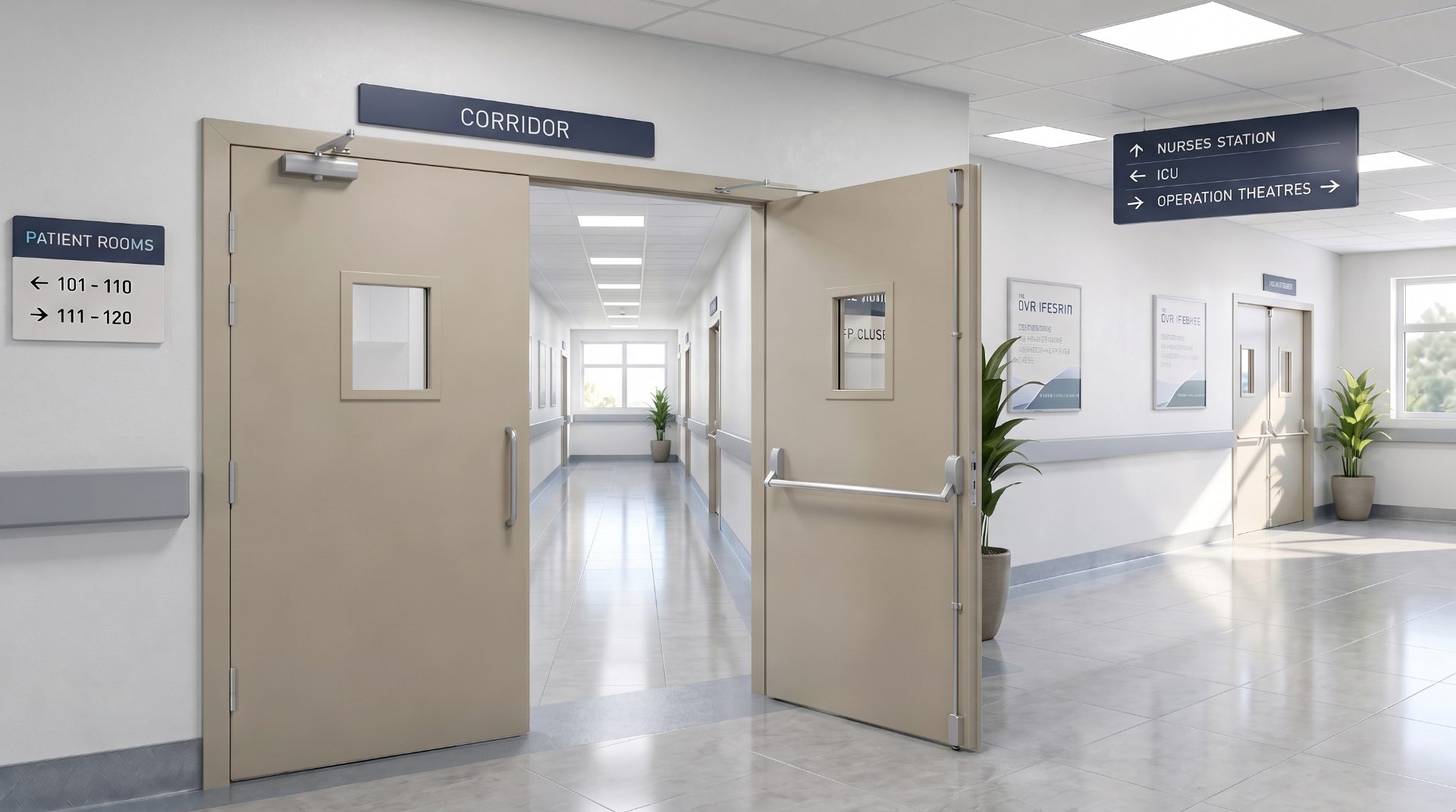
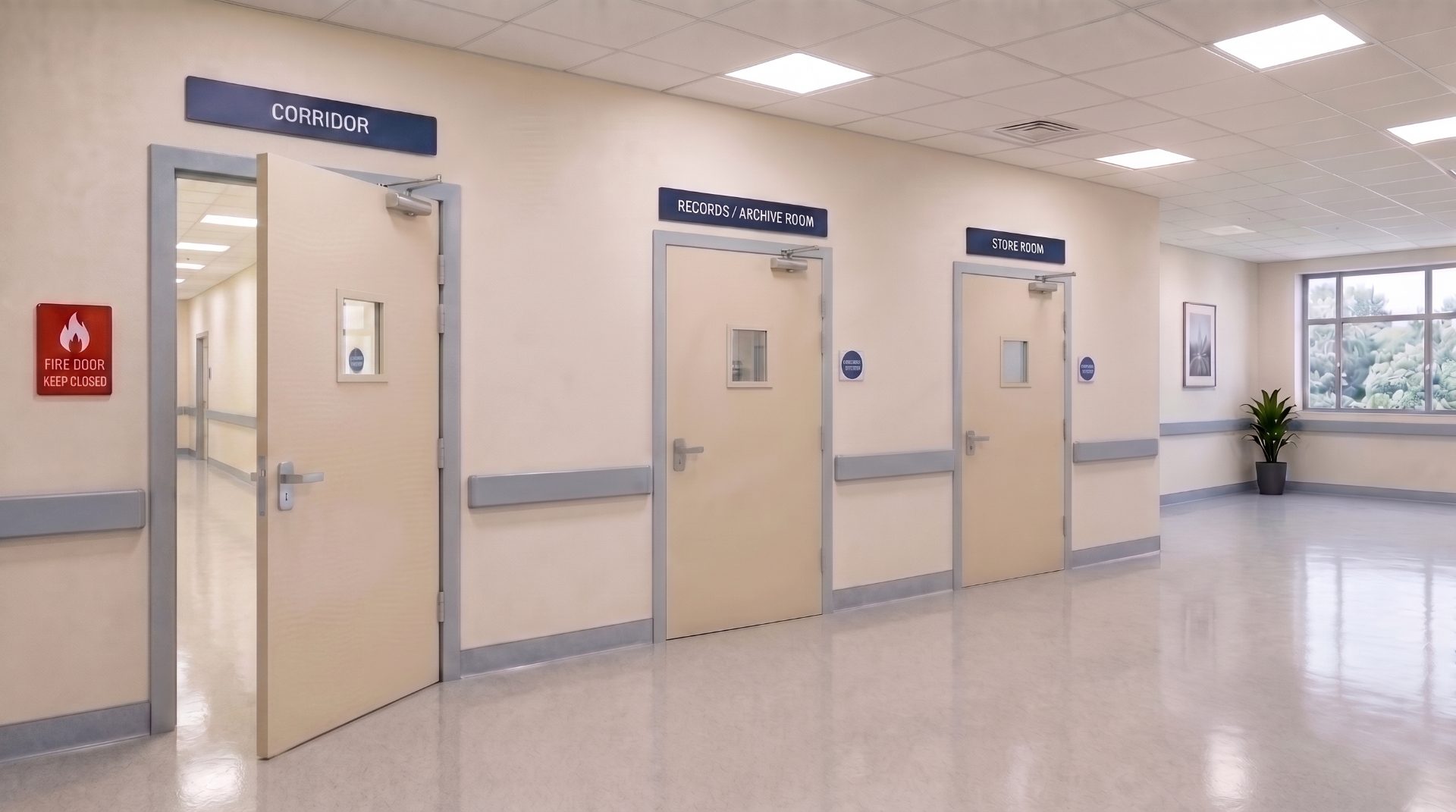
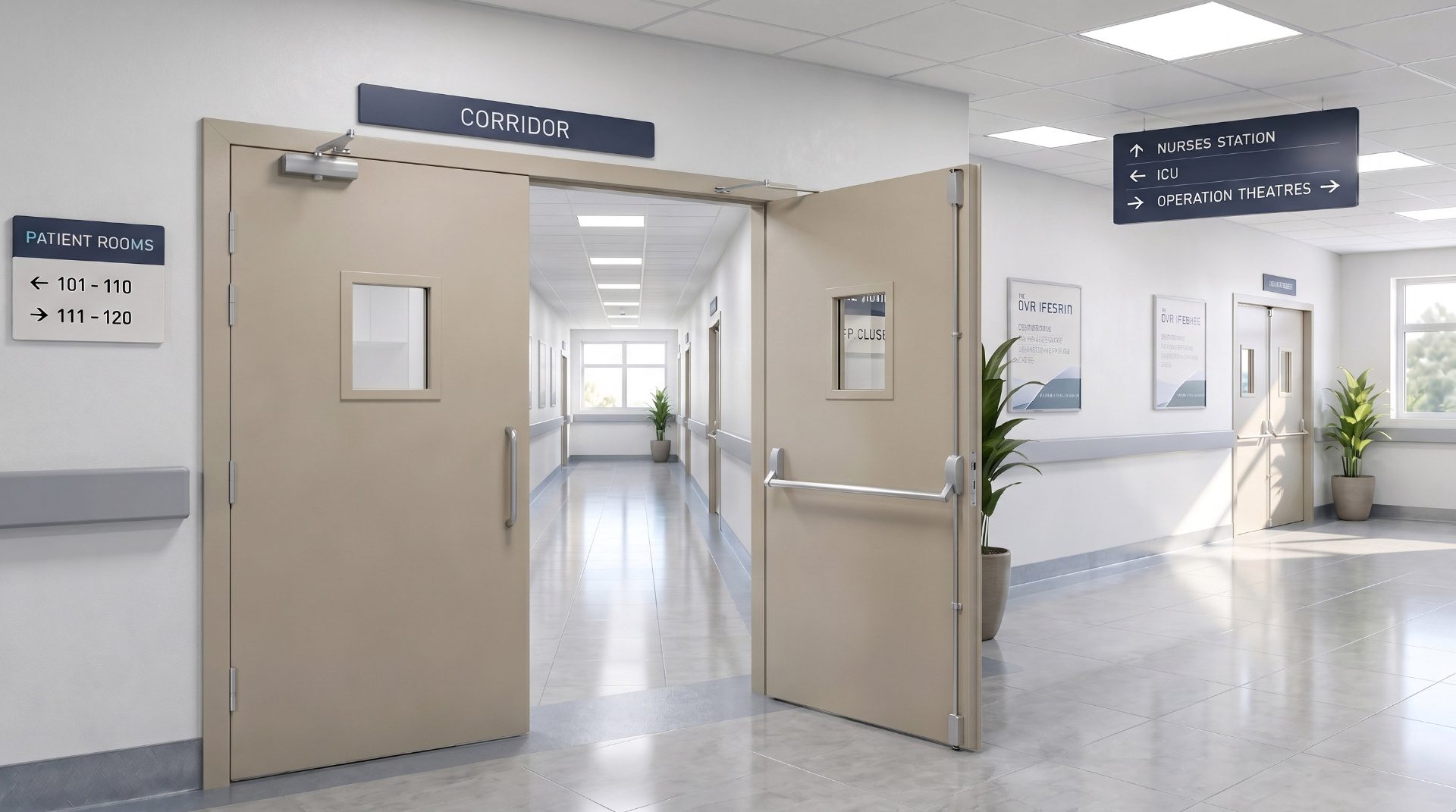
For institutional occupancies the Code goes further and specifies the configuration itself. Clause 6.3.2(d) requires that corridor door openings shall be not less than 2.0 m in width of double swing double leaf type door, with a relaxation in Clause 6.3.2(g)(9) allowing that 2.0 m to be reduced to a minimum of 1.5 m where two such doors are provided in the area. In other words, the decision in a hospital corridor is not a preference. The Code has already made it, and the door schedule only has to record it.
Annex K of the same part adds the provision that specifiers most often miss, because it puts a floor under the active leaf rather than the opening: if double leaf doors wider than 1 200 mm are provided in egress routes serving train ways, the size of the active leaf shall not be less than 810 mm. That clause exists because of how a double leaf set is actually used. With the inactive leaf bolted shut, as it is for most of the building's life, the width a person can walk through is the active leaf alone, less the frame rebate and anything projecting from the face. A 1 800 mm pair split evenly behaves like a 900 mm door in daily use; split unevenly it can behave like a door narrower than the single leaf it replaced.
A double leaf door is certified as a double leaf door
Clause 7.2.5 of IS 3614:2021 introduces the subject plainly. There are various constructions used for the manufacture of fire doors, it says, and these can be used in a number of configurations, which vary from single leaf and double leaf single swing. Then it adds the sentence that governs everything downstream: it is important to note that doors tested in one configuration might not be suitable for another configuration. Read it alongside Amendment No. 1, established on 3 July 2023 and notified in the Gazette of India, which is now part of the standard.
That sentence was tested in practice. A manufacturer asked the Fire Safety Sectional Committee, CED 36, to confirm whether a single leaf doorset needs a single leaf test report and a double leaf doorset a report applicable to double leaf doors. The committee recorded in its 2024 agenda papers that a double leaf fire door passing a fire test according to IS 3614:2021 does not guarantee compliance for single leaf fire doors, that any change in components within a fire door assembly, particularly the door leaf, can significantly impact fire performance, and it decided that separate test certificates shall be obtained for both double and single leaf fire doors.
The decision runs against the intuition most project teams start with, which is that the bigger, harder specimen must cover the smaller one. That view was put to the working group, by members who argued that if a double leaf fire door is tested there is no need to test the single leaf fire door of smaller size, and it was referred to CBRI for inputs rather than adopted. What stands as a minuted decision is the requirement for separate certificates. A submittal that offers one certificate for both configurations is incomplete on the face of it, which is the kind of gap we set out more generally in our walkthrough of IS 3614:2021.
The certification point is not confined to the test report either. The product manual that BIS publishes for IS 3614:2021 defines the scope of a licence as a set of recorded fields, and door leaf configuration is one of them, with single leaf and double leaf as the two values. A licence is therefore specific about which configuration the Standard Mark covers.
Verifying a double leaf doorset at submittal stage is therefore mechanical rather than a judgement call. Read the configuration field on the scope of licence, read the size field, and read the fire test report the licence rests on; if any of the three describes a single leaf, the pair in front of you is outside the evidence. The product manual published on the BIS website also records what forces a retest: any change in material, design or construction, or in overall perimeter, width, height or vision pane size. Turning a certified single leaf into a pair changes construction, perimeter and width at once. How to read the certificate and the licence together is set out in our guide to verifying fire door certification.
The meeting stile is the edge a single leaf does not have
Physically, the difference between the two configurations is one line. A single leaf closes against frame on every edge that matters. A double leaf closes against frame on the outer edges and against the other leaf down the middle, where there is no frame behind the joint at all. IS 3614:2021 treats that line as a sealing requirement in its own right.
Clause 7.2.6 states that intumescent seals shall be provided by the fire door manufacturer on all three sides of the door leaf and on the meeting stile of the double leaf door, or as per test evidence, and that alternatively the same can be provided on the frame and meeting stile of the double leaf door. The clause then ties the seal back to the test: it is essential that the intumescent seal to be used is of the same formulation, dimensions and configuration as the one in the manufacturer's fire test report. Note 1 under the clause confirms that all fire doors are required to have smoke seal and intumescent seal as standard components, so the obligation is not limited to the insulated types.
Two consequences follow. The meeting stile has to appear on the drawing as a detailed joint, with the seal shown and its formulation stated, not as a line where two leaves happen to touch. And because the seal has to match the tested configuration, that detail is not something a site team can improvise when the leaves do not quite meet. The seal types and where each belongs are covered in our piece on smoke seals and intumescent strips.
Three ways a double leaf set fails an inspection a single leaf would pass
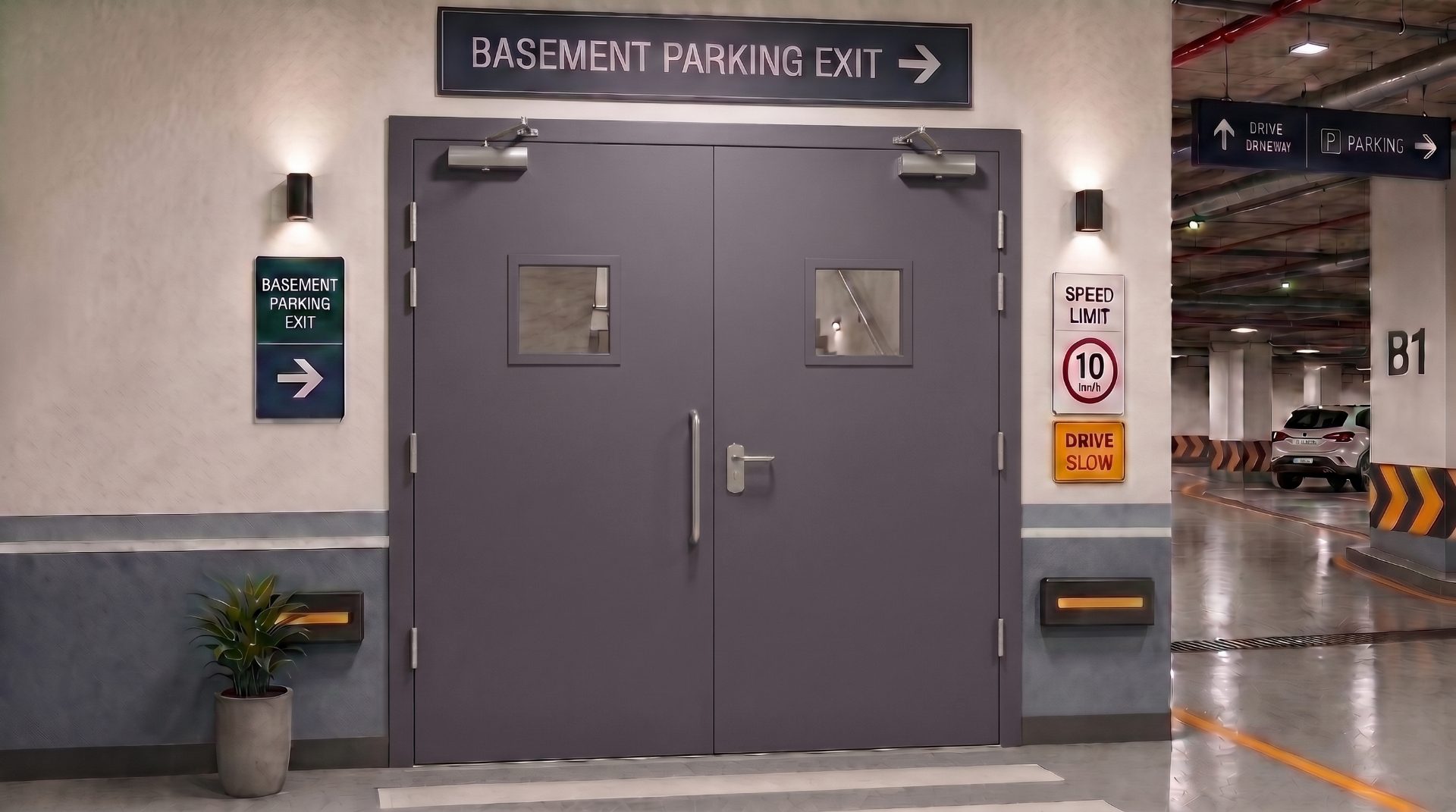
None of these involve a defective leaf. Each is a decision taken about the inactive leaf, usually late, usually by someone reading a hardware schedule that did not mention it.
1. Tower bolts on the inactive leaf
Clause 7.2.9 k) of IS 3614:2021 lists hardware that a fire door shall not have, and tower bolts are the first item on that list. The exclusion was challenged. In 2024 a manufacturer asked the working group to permit tower bolts on the inactive leaf of double leaf wooden fire doors in service areas, arguing that the alternative, flush bolts, is normally used on steel doors and that tower bolts are the practical fitting for wooden ones. The group declined, recording that it should not dilute the broad-based standard for a specific condition, and noted that as per 7.2.9 k) the automatic flush bolts are allowed, which are a better alternative to the tower bolts. Clause 7.2.9 k) was maintained as written.
A surface tower bolt is the cheapest way to hold an inactive leaf shut, and it is what gets fitted when the hardware schedule is silent, which is why this is the commonest defect on a double leaf set. Specify the inactive leaf hardware by name. The broader hardware position, including closers and locks, is covered in our article on fire door hardware requirements.
2. Seals cut away to fit the bolt
The objection the manufacturer raised to the working group is a real one even though the request was refused: fitting bolts into the head and foot of a leaf can mean cutting into exactly the edges that carry seals. It does not make the bolt non-compliant, it makes the installation method matter. A mortice for an automatic flush bolt belongs in the factory, in a leaf designed to receive it, with the seal routed around it as tested. Cut on site, it removes part of the seal line and leaves the doorset outside the configuration that was certified, which is the same failure mode as a site-cut vision aperture.
3. Leaves that close in the wrong order
A double leaf set only seals when the inactive leaf is home first and the active leaf closes onto it. Released together, the active leaf arrives first and the pair comes to rest with the meeting stile open. The standard's own discipline applies here as it does to seals: what was supplied has to match what was tested. So the question to put to the manufacturer is specific. What closing arrangement was on the tested specimen, and is the doorset being supplied with the same one? Ask it at submittal stage rather than at handover, because the answer determines what goes in the hardware schedule.
Where each configuration fits
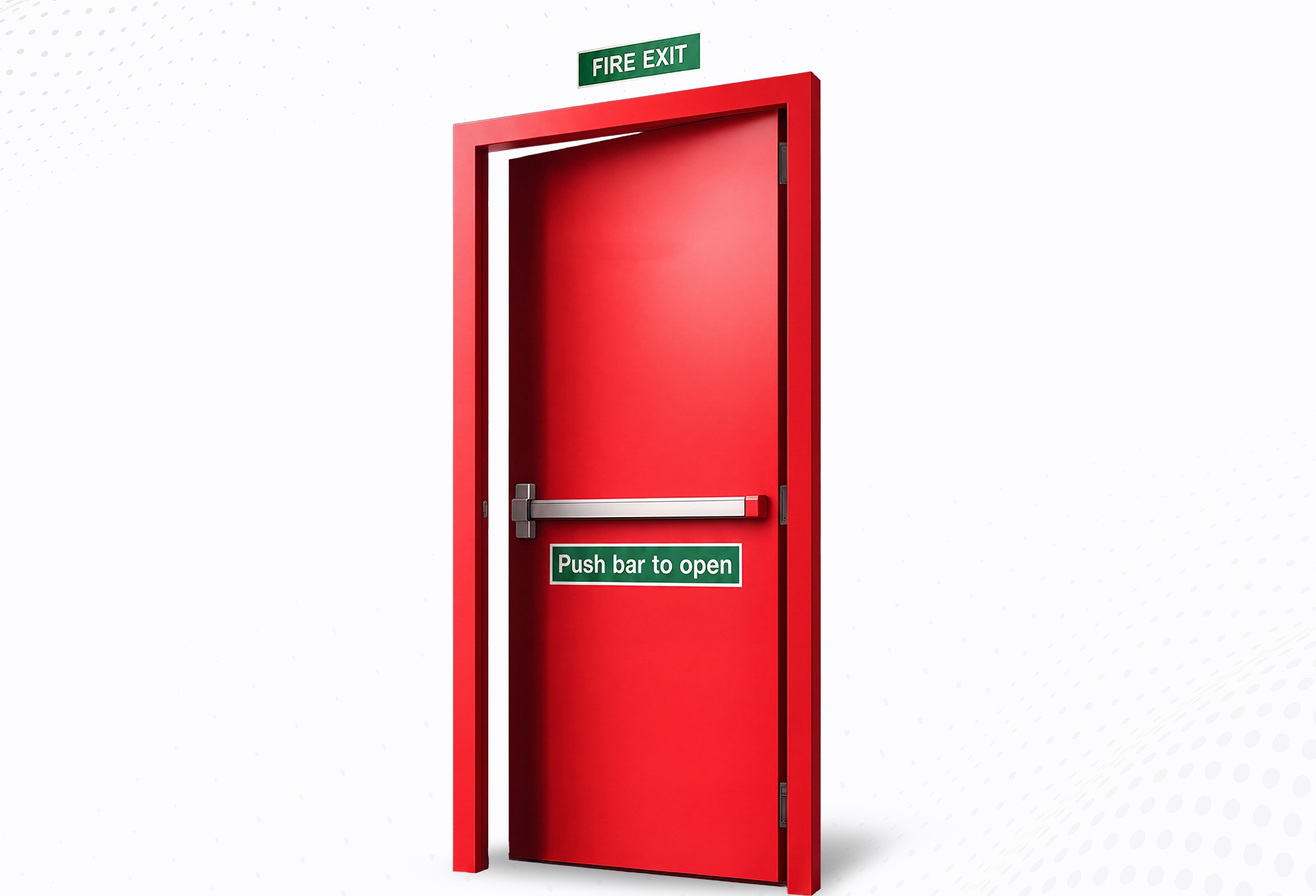
Single leaf is the default for most compartment and stair doors: the code width is met in one leaf, and fewer closing edges means fewer things to get wrong. Double leaf is specified where the Code or the use of the opening demands a width a single leaf cannot deliver — institutional corridors under Clause 6.3.2(d), assembly building exits at 2 000 mm, plant and equipment routes, and wide lobby openings on a compartment line. Valtrix manufactures both configurations in fully insulated, partially insulated, uninsulated and acoustic construction to IS 3614:2021, in ratings from FD30 to FD180; the detail for each is on the product range page.
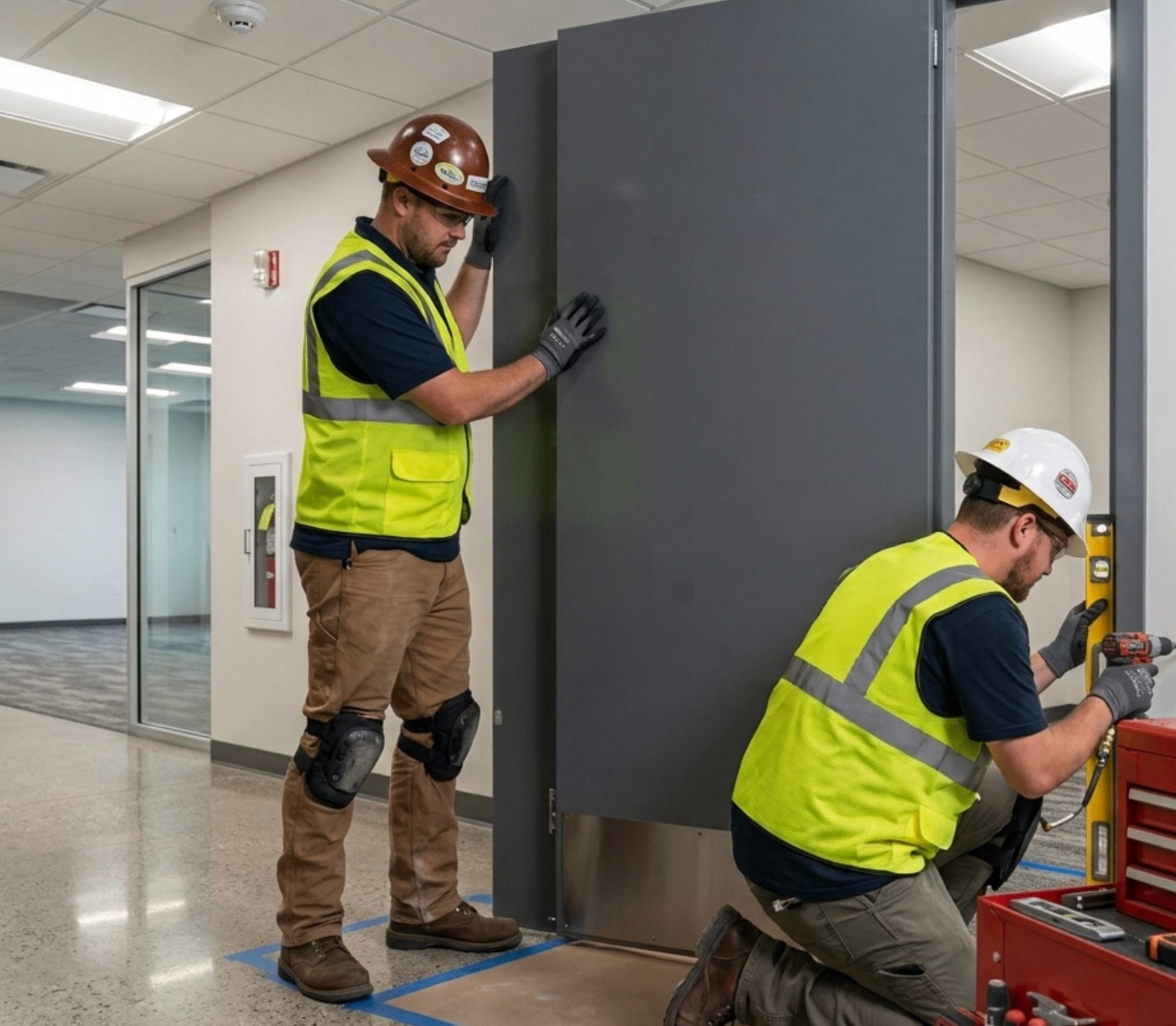
One last point on sequencing within a project. Because the two configurations are certified separately, a late change from a single leaf to a pair is not a dimensional revision. It is a different product, with a different report and a different line on the licence. Catch it at the door schedule stage, when the egress width calculation is first done, rather than at the point where the frames have been grouted into the opening. The high-rise egress figures that usually drive that calculation are set out in our piece on NBC 2016 fire door requirements.
Frequently asked questions
Does a double leaf fire door need its own fire test certificate?
Yes. The Fire Safety Sectional Committee, CED 36, recorded in its 2024 agenda papers that separate test certificates shall be obtained for both double and single leaf fire doors. The basis is Clause 7.2.5 of IS 3614:2021, which states that doors tested in one configuration might not be suitable for another configuration. A single leaf report at the same rating is not evidence for a double leaf doorset.
Can a single leaf door be supplied against a double leaf test report?
No. The committee specifically noted that a double leaf fire door passing a fire test according to IS 3614:2021 does not guarantee compliance for single leaf fire doors, and that any change in components within a fire door assembly, particularly the door leaf, can significantly impact fire performance. The view that a larger tested specimen automatically covers the smaller one was put to the working group and referred to CBRI rather than adopted.
What hardware is not allowed on a double leaf fire door in India?
Clause 7.2.9 k) of IS 3614:2021 lists hardware that a fire door shall not have, and tower bolts appear on that list. A 2024 request to permit tower bolts on the inactive leaf of double leaf wooden fire doors in service areas was declined by the working group, which noted that automatic flush bolts are allowed under the same clause and are a better alternative.
Does the meeting stile of a double leaf fire door need an intumescent seal?
Yes. Clause 7.2.6 requires intumescent seals on all three sides of the door leaf and on the meeting stile of the double leaf door, or as per test evidence, with the alternative of providing them on the frame and the meeting stile. The seal must be of the same formulation, dimensions and configuration as the one recorded in the manufacturer's fire test report.
What is the minimum width of a fire exit door in India?
NBC 2016 Part 4, Clause 4.4.2.4.1(b), states that no exit doorway shall be less than 1 000 mm in width, except in assembly buildings, where the door width shall be not less than 2 000 mm. The same sub-clause requires doorways to be not less than 2 000 mm in height. Institutional corridor door openings are separately required by Clause 6.3.2(d) to be not less than 2.0 m wide in a double swing double leaf type door.
How wide must the active leaf of a double leaf door be?
NBC 2016 sets an explicit floor in Annex K for one case: where double leaf doors wider than 1 200 mm are provided in egress routes serving train ways, the size of the active leaf shall not be less than 810 mm. Outside that case the Code states widths for the doorway rather than the leaf, so the active leaf width should be checked against the clear width the route actually needs, since the inactive leaf is normally secured.
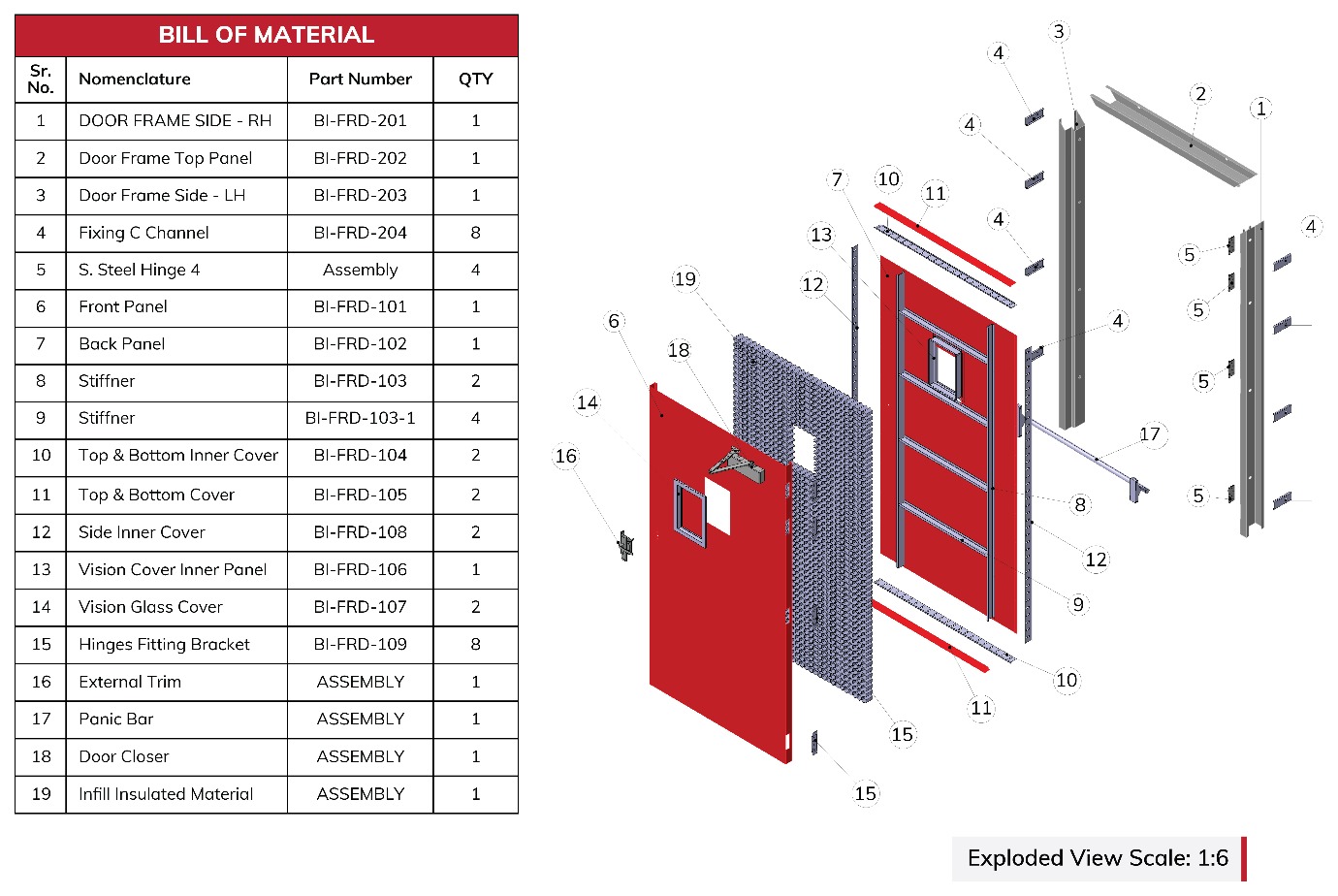
 Fully InsulatedView Details →
 Partially InsulatedView Details →
 UninsulatedView Details →
 AcousticView Details →