
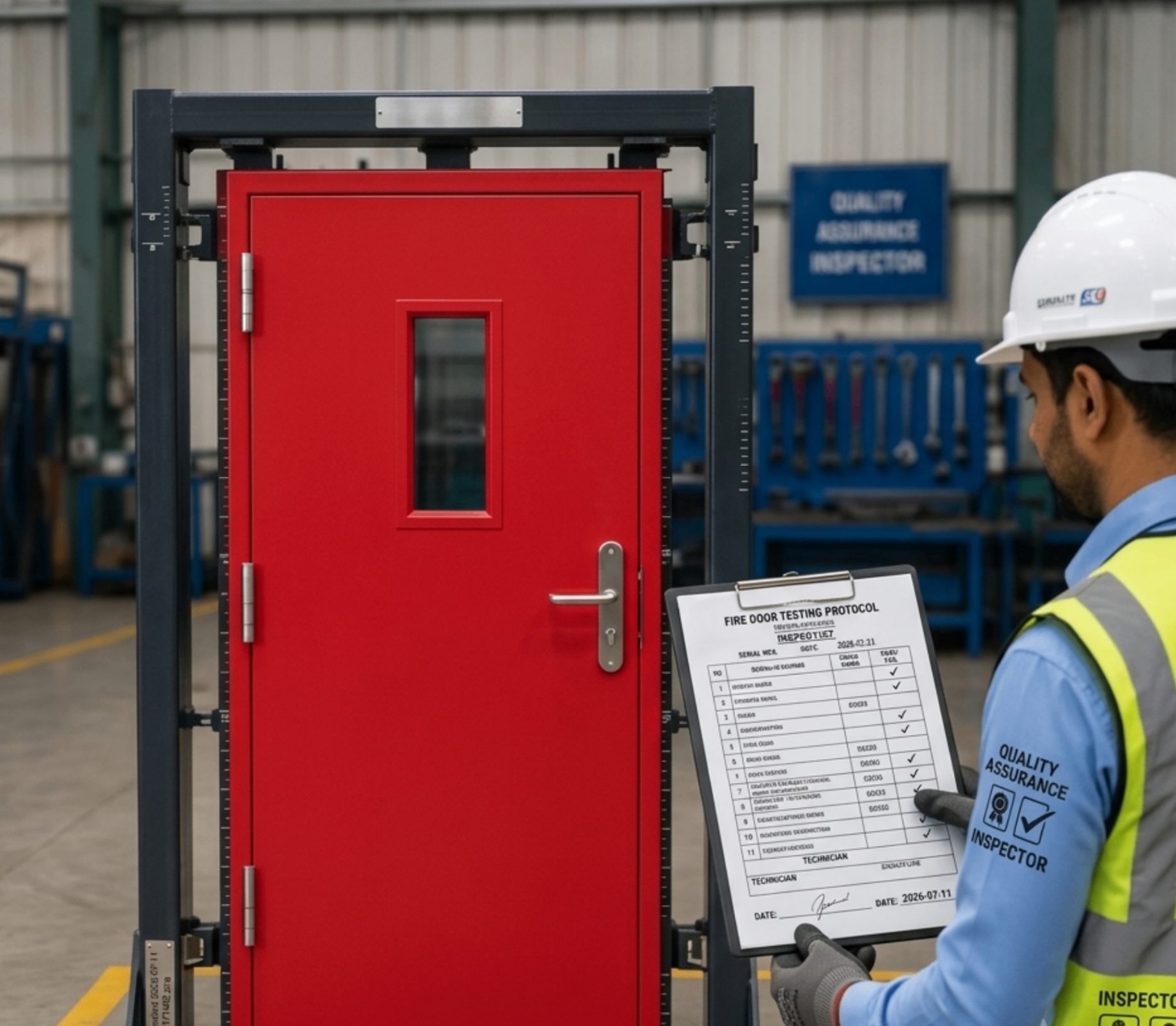
A CBRI certificate, a BIS licence and an ISI mark are three different things, and only one of them can be checked by a stranger in under a minute. A fire door can hold a valid test report and still carry no BIS licence at all. Here is how to tell what a supplier actually has.
The distinction matters because the three documents fail in different ways. A test report goes out of date silently when a design changes. A BIS licence expires on a calendar. A letter of compliance is worth exactly as much as the report standing behind it. What follows is what each document means, what it does not cover, and the checks that take about a minute each.
Three documents, three different meanings
1. The fire resistance test report
This is the laboratory record of one doorset being put in a furnace. Clause 4.1 of IS 3614:2021, as amended, requires fire resistance to be determined by subjecting a full-size construction to test in accordance with IS 17518 (Part 1), the Indian test method standard for door and shutter assemblies. Before Amendment No. 1 of July 2023 the same clause pointed to IS/ISO 3008-1. A report citing the older method is not thereby invalid, but it does date the test.
CSIR-CBRI at Roorkee is the best known of the laboratories that run this test, and its Fire Safety Engineering group lists fire resistance evaluation of building elements to IS 3614:2021 among its services. It is not the only one. The Bureau of Indian Standards lists eleven laboratories against IS 3614:2021 at the time of writing. So a CBRI certificate for a fire door describes who did the testing. It is not a grade above other recognised laboratories, and on its own it says nothing about the door being delivered to your site.
That last point is the one buyers miss. The report covers the specimen that was tested. Annex C of IS 3614:2021 sets out the typical contents of a test report along with a fire door test certificate format, and clause 4.1 states that a certificate ceases to be valid on a change in design and construction, or where components are modified without re-testing. A different leaf thickness, a different infill, a vision panel where the specimen had none, a substituted closer: each is a different door from the one in the furnace.
2. The BIS licence and the ISI mark
A BIS licence is a different kind of assurance. Granted under section 13 of the BIS Act 2016, it entitles the holder to apply the Standard Mark, the ISI mark, to product within a defined scope. Where a test report certifies one specimen, a licence certifies an ongoing manufacturing system, backed by a documented scheme of inspection and testing and by the Bureau's own surveillance.
The BIS product manual for IS 3614:2021 sets out what that scheme asks of a licensee: in-process control of sizes, construction, frames, leaves, intumescent seals, vision panes, louvres and hardware; verification of ISI marking on incoming raw materials; a calibration plan for test equipment; and a full fire resistance test on one doorset every five years, or on a design change. Testing may be subcontracted to laboratories recognised by the Bureau, or to government laboratories empanelled by it.
3. The manufacturer's letter of compliance
Annex C also gives the format for a letter of compliance: the manufacturer's own statement that the doors supplied against a purchase order match a tested configuration. It is a normal and useful document. It is not third-party certification, and it should be read alongside the test report it refers to, never instead of it.
Why hardly any fire door in India carries an ISI mark
Buyers who go looking for an ISI mark fire door and cannot find one tend to assume the market is cutting corners. The explanation is duller. Clause 8.4 of IS 3614:2021 is permissive rather than mandatory: a product conforming to the standard may be certified under the conformity assessment schemes of the BIS Act 2016, and the product may be marked with the Standard Mark.
Fire doors are not listed among the products under compulsory certification under Scheme-I, and IS 3614 does not appear in the Bureau's list of Quality Control Orders notified and due for implementation. BIS certification for fire doors is therefore voluntary at present, and 29 licences are listed against the standard on the Bureau's public register at the time of writing, for the whole country.
The absence of an ISI mark on a fire door is not by itself a red flag, then. The absence of any traceable document is.
How to verify a BIS licence in about a minute
This is the part the page-one guides leave out. If a supplier claims a BIS licence, ask for the CM/L number and check it yourself rather than reading it off a letterhead.
The Bureau publishes a Know Your Standards register on its services portal. The entry for IS 3614:2021, under the CED 36 Fire Safety Sectional Committee, lists the current licences against the standard and the laboratories recognised for it. The BIS Care app does the same from a phone through its Verify Licence Details function, and lets you register a complaint about misuse of the Standard Mark.
Two things to check once you have found the licence.
- Is it current? The Bureau's renewal guidelines, issued under Regulation 8 and Paragraph 9 of Scheme-I of Schedule-II of the BIS (Conformity Assessment) Regulations, 2018, allow renewal for a minimum of one year and up to five. Once a licence expires the holder is not entitled to mark product with the Standard Mark, nor to claim in advertising or publicity that it is a licensee, and product marked after that date is deemed to be marked illegally under the BIS Act 2016.
- Does its scope cover your door? Almost nobody makes this check. The scope of licence is written parameter by parameter: door type, fire rating, insulation type, doorway size, material thickness, infill material and vision pane. A licence covering an FD60 uninsulated single leaf says nothing about an FD120 fully insulated pair. The grouping rules give cover in one direction only, the largest doorway size tested covering smaller ones and the maximum material thickness covering thinner, so a licence never stretches upward to a door larger or heavier than what was tested.
What has to be on the door itself
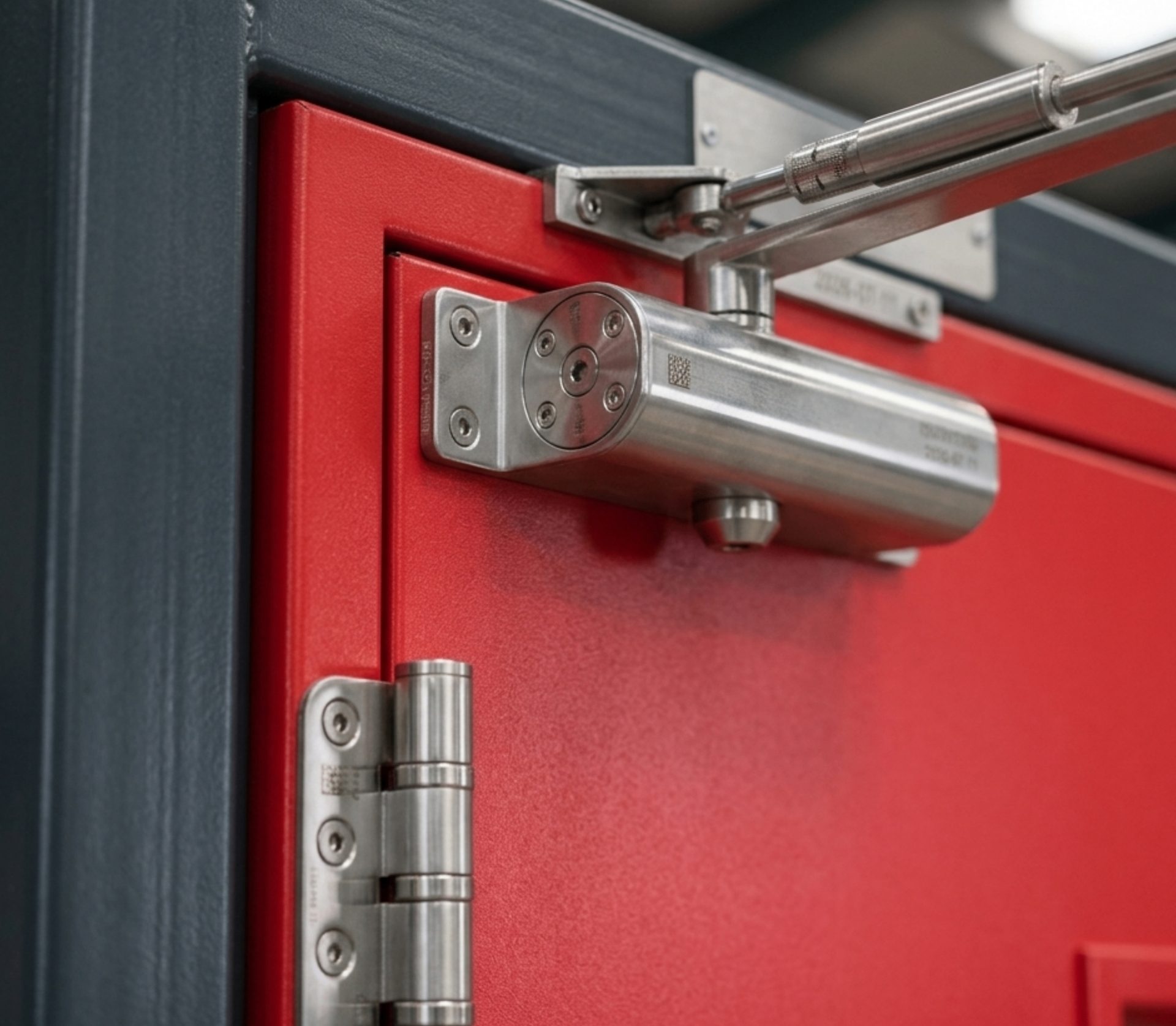
How to check if a door is fire rated, once it is installed, starts at the label. Clause 8.3 of IS 3614:2021 requires six fields: name of the manufacturer, type of fire door, fire rating classification, serial number of the door, year of manufacture, and certificate reference number. Read all six. The serial number and certificate reference are what let an inspector walk backwards from a door in a corridor to the report it was built against. A label missing them ends the audit trail at the door.
Clause 8.1 puts the matching obligation on the manufacturer, who must maintain records covering project name, purchase order details, serial number, year of manufacture, fire rating and label details. Clause 8.5 requires test data to be made available to the concerned authorities on request. Between them, those clauses are why a serious supplier answers a document request in a day rather than a fortnight.
Where a manufacturer does hold a licence, the product manual additionally requires the label to carry the Standard Mark together with the line directing readers to the BIS website for details of the certification. An ISI mark with no CM/L number to check is not evidence of anything.
The document request to send before you order
Send this list to every shortlisted supplier at enquiry stage, not after the purchase order is placed.
- The fire resistance test report in full, not the cover page, for the configuration you are actually buying, tested to IS 17518 (Part 1), naming the laboratory.
- The specimen description from that report, so leaf construction, infill, frame profile, glazing and hardware can be compared against what is being quoted for your project.
- The letter of compliance in the Annex C format, referencing both the report and your purchase order.
- The CM/L number and the scope of licence, if a BIS licence is claimed, so you can verify both on the public register.
- A sample label showing all six clause 8.3 fields as they will appear on your doors.
- Hardware documentation, because the doorset is certified as an assembly: hinges, closer, lock, panic hardware and intumescent seals all have to match the tested configuration.
Whatever a supplier cannot produce at enquiry stage, assume you will be chasing at handover. A fire officer or an insurer will ask for the same papers later, and by then there is no option to move on to the next vendor. For the wider set of checks that follow once the doors are installed, see our fire door inspection checklist for Indian buildings, and for the clause-by-clause read of the product standard, our guide to IS 3614:2021.
Valtrix fire doors are tested and certified in accordance with applicable IS 3614:2021 requirements, in FD30, FD60, FD90, FD120 and FD180 configurations, in fully insulated, partially insulated, uninsulated and acoustic types, single and double leaf. Project-specific test reports, material declarations and installation documentation are supplied against the project brief. See our certificates and compliance page or the product range.
Frequently asked questions
Is a CBRI certificate mandatory for fire doors in India?
No. There is no requirement that testing be done at CSIR-CBRI specifically. IS 3614:2021 requires fire resistance to be determined by test to IS 17518 (Part 1), and the Bureau of Indian Standards lists eleven laboratories against the standard. What a specifier should insist on is a full report from a recognised laboratory for the configuration being supplied, whichever laboratory ran it.
What is the difference between a CBRI test report and BIS certification for fire doors?
A test report records how one tested specimen performed in a furnace on one day. A BIS licence certifies that a manufacturer operates a scheme of inspection and testing across production, and permits the ISI mark within a defined scope. They answer different questions, and neither substitutes for the other.
How do I check if a fire door is really fire rated?
Start with the label and confirm all six fields required by clause 8.3 of IS 3614:2021 are present, particularly the serial number and certificate reference number. Then ask the supplier for the test report that reference points to and compare the specimen in it with the door in front of you. If a BIS licence is claimed, verify the CM/L number on the Bureau's public register.
How long is a fire door test certificate valid?
A test certificate carries its own validity period, but validity is not only a matter of dates. Clause 4.1 of IS 3614:2021 provides that a certificate ceases to apply where the design and construction change or components are modified without re-testing. A certificate within its date range can therefore still fail to cover the door being supplied.
Does an ISI mark on a fire door mean every door from that maker is covered?
No. The scope of licence is defined parameter by parameter, including door type, rating, insulation type, doorway size, material thickness, infill and vision pane. Always read the scope alongside the licence number, and check that the door you are buying sits inside it.
Which standard should a current fire door test report cite?
IS 17518 (Part 1). Amendment No. 1 to IS 3614:2021, issued in July 2023, replaced the earlier reference to IS/ISO 3008-1 in clause 4.1 and in Annex C. The same amendment introduced the fully insulated, partially insulated and uninsulated designations used to classify doors today, so a report predating it will often use the older terminology.
Primary sources for this article: the Bureau of Indian Standards register entry for IS 3614:2021, the BIS product manual for IS 3614:2021, and the CSIR-CBRI Fire Safety Engineering testing services listing. For what the ratings themselves mean, see our explainer on FD ratings.