
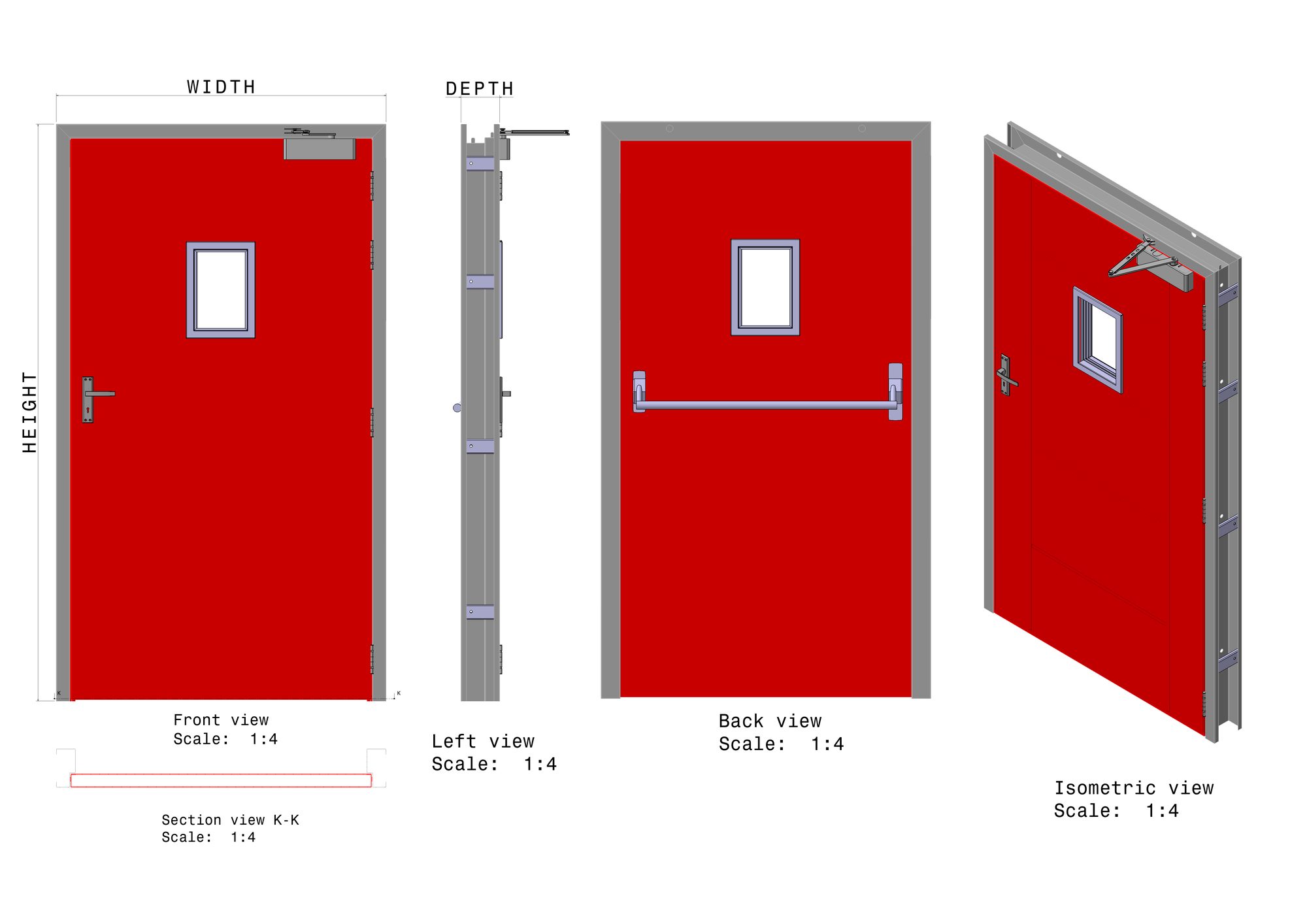
IS 3614:2021 is the Indian Standard for fire doors and doorsets. It sets what an IS 3614 fire door must be made of, how it is classified by integrity and insulation, and what its label must carry. It replaced the two-part standard of 1966 and 1992, and Amendment No. 1 of July 2023 then changed the test reference and the classification table.
That last sentence is where most specifications quietly go wrong. A test report issued against the standard as first published cites a different test method from one issued today, and the classification wording a supplier quotes may predate the amendment. Neither is necessarily a problem. But if you cannot tell which version a document refers to, you cannot tell what was actually tested. What follows is the standard read clause by clause, ending with what to ask a supplier for.
What IS 3614:2021 replaced, and why
Fire doors in India were governed for decades by a two-part standard. IS 3614 (Part 1) : 1966 covered fire-check doors of the plate, metal covered and rolling type. IS 3614 (Part 2) : 1992 was the test document, specifying, in its own words, "methods of fire-resistance test and the performance criteria for the fire check door or shutter provided to resist the passage of fire and/or gaseous products of combustion".
The 2021 revision folded both into a single specification, published by the Bureau of Indian Standards on 25 May 2021 under technical committee CED 36. The foreword gives the reason plainly: since publication, "lot of improvements and developments including in the construction material and construction technology of fire rated doors had taken place". The revision was also aligned to the National Building Code of India 2016, Part 4 (Fire and Life Safety).
The scope widened with it. Clause 1 covers quality requirements, materials and details of construction for "fire rated metal swing doors, wooden composite swing doors, metal sliding doors and metal rolling shutters", through to installation and maintenance, so that an opening does not become the weak point in a compartment wall.
One detail matters for anyone working from older paperwork: the 1992 part listed durations up to FD 240. The 2021 classification runs FD 30 to FD 180.
Integrity and insulation: the two criteria behind every rating
Every FD number is shorthand for a duration measured in a furnace test. What is being measured is defined in the terminology clauses, and the two definitions do very different work.
Integrity (clause 3.51) is the ability of a separating element, exposed to fire on one side, to prevent the passage of flames and hot gases. A door that distorts away from its frame, or opens a path through a gap, has failed integrity whatever else it is doing.
Insulation (clause 3.52) is resistance to temperature rise on the unexposed face: a maximum of 180 °C at any single point and a maximum average of 140 °C. This is the criterion that decides whether people can pass close to the door, and whether material stored on the far side can reach ignition temperature without a flame ever touching it.
The fire resistance rating (clause 3.34) is the time in minutes the assembly withstands the standard fire exposure. So FD 60 means sixty minutes against the criteria that door is classified for, which is not the same as sixty minutes of protection in every respect. Our guide to what an FD rating actually means works through the ladder in more detail.
How the standard classifies a fire door: ID, PI and UD
This is the section Amendment No. 1 rewrote, and the one that quotations are still loosest about. The amendment restructured clause 5.2 into three named classes:
- Fully insulated (ID) — clause 5.2.2. Insulation performance matches the integrity rating. An FD 120 ID door holds both criteria for 120 minutes.
- Partially insulated (PI) — clause 5.2.1. Integrity to the full rating, with a minimum of 30 minutes of insulation. An FD 120 PI door is not an FD 120 ID door, and the difference shows from minute 31.
- Uninsulated (UD) — clause 5.3. Tested and classified on integrity alone.
A rating on its own tells you less than it appears to. "FD 120" without a class letter does not say what happens to the unexposed face. Ask for the class alongside the number, and get it on the quotation rather than in conversation. Valtrix manufactures all three classes in single and double leaf, from FD30 to FD180; the product range sets out which class suits which application, and this guide to fire door types covers the practical differences between them.
The test reference changed in 2023
Clause 4.1 of IS 3614:2021 as published required fire resistance to be determined by testing a full-size construction to IS/ISO 3008-1. Amendment No. 1, issued in July 2023, replaced that reference with IS 17518 (Part 1), and updated Annex C to IS 17518 (Part 1) : 2022.
IS 17518 (Part 1) : 2022 is "Fire Resistance Tests — Door and Shutter Assemblies, Part 1: General Requirements", an identical adoption of ISO 3008-1:2019, also under CED 36. Its record in the BIS standards database lists it as active with no amendments of its own.
The practical consequence is a single question worth asking of any test report put in front of you: which test standard does it name? A report citing IS/ISO 3008-1 is not thereby invalid, but it tells you roughly when the test was run and against which edition of the reference. Current work should point at IS 17518 (Part 1).
What the standard requires of the door itself
Gaps and clearances
Clause 9.3.1.1 states that a typical gap to achieve good fire performance is between 2 mm and 4 mm. Read that as an installation tolerance as much as a manufacturing one. A door that leaves the factory correct can be hung on site outside the range, and the seal geometry the test relied on no longer holds.
Intumescent seals
Clause 7.2.6 is direct: it is mandatory for the door manufacturer to test and supply insulated doors with intumescent seal. The seal belongs to the tested assembly. It is not an accessory to be sourced separately or added at site.
Vision panels
Clause 6 caps the glazed area at 0.12 m² for an uninsulated door and 0.06 m² for an insulated door. This catches design teams out regularly. A vision panel sized for a corridor sightline can exceed the limit for the class being specified, and the choice then is a smaller panel or a different class, decided early rather than at shop-drawing stage.
Size limits
Amendment No. 1 revised clause 7.2.2 to cap the opening at 7.2 m², with a maximum width of 2.4 m and a maximum height of 3.0 m. Clause 7.3.2, covering wooden composite doors, had its size limits updated and a site installation restriction added. Openings beyond these limits need a different product type, not a larger version of the same one.
Hardware
Clause 7.2.9 deals with hardware: that it should be fire rated and certified, with an exception for hinges of minimum 100 mm × 75 mm × 3 mm in stainless steel. Amendment No. 1 changed "shall" to "should" in three places in this clause. That is worth knowing when a specification is being argued over, because the obligation as drafted in 2021 and the obligation as amended are not identical.
What must appear on the label
Clause 8.3 lists what the label on a fire door must carry:
- Name of the manufacturer
- Type of fire door
- Fire rating classification
- Serial number of the door
- Year of manufacture
- Certificate reference number
Clause 8.4 provides that a product conforming to the standard may be certified and marked with the BIS Standard Mark. The label is the cheapest audit available on a site walk: a door carrying no serial number and no certificate reference cannot be traced back to a test report at all, and nothing else about it can be checked.
How to verify a supplier meets IS 3614:2021
1. Ask for the class, not just the number
ID, PI or UD changes what the door does once the insulation period ends. Put the class letters on the purchase specification.
2. Read which test standard the report names
IS 17518 (Part 1) for current work, IS/ISO 3008-1 on older reports. If neither appears anywhere in the document, ask what was tested and to which method.
3. Check the tested configuration against your opening
Test reports are specific about leaf size, single or double leaf, frame type, glazing and hardware. A report covering a single-leaf door does not cover a double-leaf pair, and your opening still has to sit inside the size limits in clause 7.2.2.
4. Match the label to the paperwork
Clause 8.3 gives you six fields to check. Compare the certificate reference number stamped on the door against the certificate you were issued, on a sample of the delivery rather than one door.
5. Confirm the seals and hardware are the tested ones
A substituted closer, a different lock or a missing intumescent seal moves the assembly away from what was tested, and the rating describes the assembly rather than the leaf.
6. Measure the installation gap at handover
2 mm to 4 mm, per clause 9.3.1.1. Check it before the door is signed off, while it can still be corrected.
Valtrix fire doors are manufactured to IS 3614:2021, and our certificates and compliance page sets out the documentation issued with them. If the open question is which rating and class an opening calls for, this walkthrough on choosing a fire door starts from the building rather than the product. The standard itself is published by the Bureau of Indian Standards and should be purchased there rather than read from a third-party upload.
Frequently asked questions
Is IS 3614:2021 mandatory in India?
IS 3614:2021 is the product specification for fire doors and doorsets. Whether a fire door is required at a particular opening comes from the National Building Code of India 2016, Part 4, together with the state fire rules and the local fire authority that approves the building. Confirm the requirement for your project with the authority having jurisdiction.
What is the difference between IS 3614 Part 1 and Part 2?
Part 1 (1966) covered fire-check doors of the plate, metal covered and rolling type. Part 2 (1992) was the fire resistance test and performance criteria document. IS 3614:2021 consolidated both into one specification, so current work references the 2021 standard rather than either part.
What does FD60 mean under IS 3614?
Sixty minutes of fire resistance against the criteria the door is classified for. On a fully insulated (ID) door that is 60 minutes of integrity and insulation. On a partially insulated (PI) door it is 60 minutes of integrity with at least 30 minutes of insulation. On an uninsulated (UD) door it is integrity only.
Which test standard applies to fire doors in India now?
IS 17518 (Part 1) : 2022, an identical adoption of ISO 3008-1:2019, following Amendment No. 1 to IS 3614:2021. The standard as first published in 2021 referenced IS/ISO 3008-1.
Can a fire door have a vision panel?
Yes, within limits set by clause 6: up to 0.12 m² of glazing on an uninsulated door and up to 0.06 m² on an insulated door. The glazing and its beading form part of the tested assembly.
How do I check a fire door certificate is genuine?
Start with the label required by clause 8.3 — manufacturer, type, rating classification, serial number, year of manufacture and certificate reference number — then trace the certificate reference back to the test report and confirm that the configuration tested matches the door actually supplied.