
A fire NOC in Maharashtra is granted against the National Building Code, not against a pump schedule. The Maharashtra Fire Prevention and Life Safety Measures Act, 2006 defines the measures that way, and compartmentation is a large part of what the Code asks for. Doors are where drawings meet site reality, and where final approval most often stalls.
Most guides to this process explain the portal, the fees and the document list. This one covers the door side: which ratings appear in Maharashtra's own regulations and circulars, and what has changed recently.
What the approval is actually granted against
Section 2(5) of the Maharashtra Fire Prevention and Life Safety Measures Act, 2006 defines fire prevention and life safety measures as measures necessary "in accordance with the building bye-laws or as required by or under the provisions of any law or the National Building Code of India" for the prevention, control and fighting of fire and for ensuring the safety of life and property in case of fire.
That definition does most of the work. Section 3 then requires owners and occupiers to provide the measures specified against their building in Schedule-I, and to maintain them in good repair and efficient condition at all times. The approval is not a certificate about equipment on a list. It is a statement that the building matches the Code and will keep matching it.
The 2023 amendment sharpened this. It removed the year reference that had frozen the definition to the 2005 edition, so the Code as currently in force applies, and added a power to amend Schedule-I by notification to track Code revisions. For doors, a specification written against an old edition is not automatically safe.
Provisional approval, final approval, and where doors get caught
The 2023 amendment also names three distinct approvals: Provisional Fire Safety Approval, Final Fire Safety Approval, and Renewal. On the state's online system, provisional approval is assessed on drawings and is issued within seven working days of the payment UTR being received. Final approval comes after construction, on inspection, and turns on whether the recommendations attached to the provisional approval were actually implemented.
This is why door problems surface late. At provisional stage a door is a line on a schedule. At final stage it is an assembly with a rating, a label, a closer, a frame and a set of gaps, all of which an inspector can see. A schedule that says "fire door" without a rating passes the first stage and fails the second.
The door ratings written into Maharashtra's own documents
The numbers below are taken from documents this state's fire authorities issue and rely on.
1. Basements and parking
Directorate of Maharashtra Fire Services circular MFS/51/2024/1140 dated 18 July 2024, issued with reference to UDCPR-2020, the 2006 Act and NBC-2016, is unusually specific. Parking structures located within, immediately above or below, attached to, or less than 3 m away from a building used for any other purpose must be separated by fire resistant walls and floors with a fire resistance rating of not less than 120 minutes. Door openings leading to the basement must be protected with fire doors with 120 minute fire rating, except for exit discharge doors. Basement staircases must be of enclosed type, with entry to basement areas "through two hours fire resistance self-closing door provided in the enclosed wall of the staircase".
In FD terms that is an FD120 doorset at the basement openings and at the basement staircase. If your basement door schedule reads FD60, the schedule is short of the circular.
2. Staircase enclosures
UDCPR-2020 defines an enclosed staircase as one separated by fire resistant walls and doors, and Regulation 9.32 carries the fire protection requirement itself. For the construction detail behind it, IS 1642:1989, the Bureau of Indian Standards code of practice on details of construction, is explicit: clause 7.5(d) requires the enclosure for staircases and hoists to be built to a 2 hour rating, with every opening from the enclosure onto a roof used as a floor, or onto any other part of the building, fitted with a fire resistant door of rating not less than 1 hour.
Clause 11.2 deals with basement staircases separately: the enclosure to 2 hours, communicating with the basement through a lobby with fire resisting self-closing doors of 1 hour fire resistance. The same clause sets the trigger for an additional staircase at a travel distance exceeding 18.50 m, worth checking against your floor plate before the door schedule is fixed.
3. Lift shafts and landing doors
Clause 13.2.1 of IS 1642:1989 puts lift enclosure walls at a 2 hour rating, landing doors at not less than 1 hour, and the lift car door at not less than 1 hour. It also rules out collapsible gates.
4. Openings in fire separating walls
Clause 5.2 of IS 1642:1989 requires every opening in a fire separating wall to be protected by a fire resisting door of not less than 1 hour, and openings serving rope races, motor alley ways and staircases to be protected to not less than 2 hours. The 2024 circular puts the same principle in procurement language: openings in fire walls and fire partitions are to be protected with approved fire doors installed in accordance with the relevant Indian Standards, naming IS 3809 for the fire resistance test. UDCPR-2020 defines fire resistance by the same reference.
Those are the test-method references. The product standard a fire doorset is certified against in India is IS 3614:2021, which is what a manufacturer's test report and certificate should cite. We have set out how to read those documents in our guide to CBRI test reports, BIS licences and ISI marks, and what the FD numbers themselves mean in FD30 to FD180 explained.
Self-closing is a requirement, not a convenience
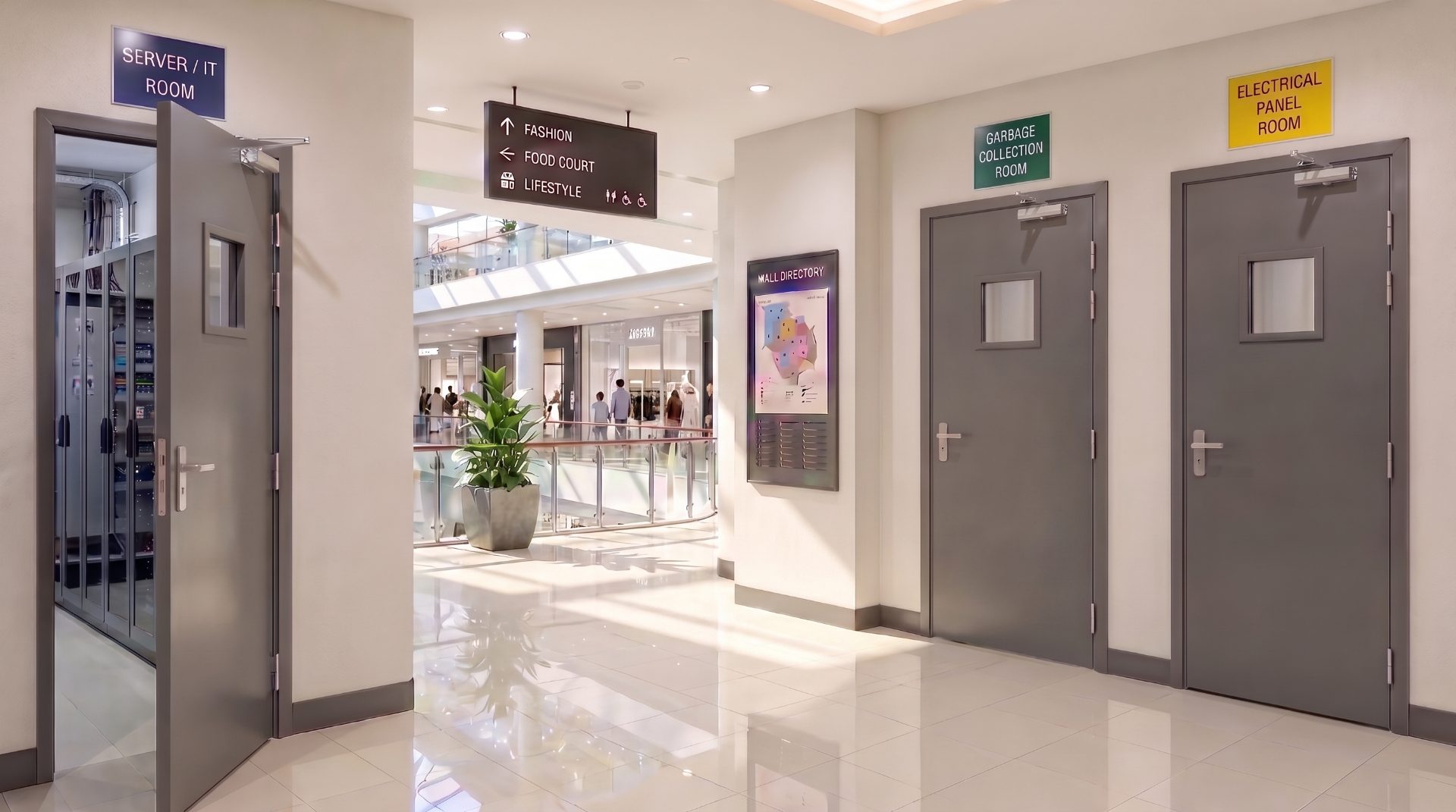
The 2024 circular does not say "fire door" at the basement staircase. It says "self-closing door", and IS 1642:1989 says the same at the basement lobby. The reason is mechanical: a rated leaf that is wedged or propped open provides no rating at all, and the compartment it was meant to close stays open.
The same circular requires staircases and lift lobbies to be held under positive pressure during a fire event, at not less than 5 mm W.G. for staircases and 2.5 mm W.G. for lift lobbies. A door that does not latch cannot hold a pressure differential, so a defeated closer quietly takes the pressurisation system out of service too.
Where a door must stand open for traffic, the answer is a hold-open device released by the detection system, not a doorstop. Our fire door inspection checklist covers the walk-round.
What changed in 2023 and 2025
Two recent instruments matter to anyone preparing a file this year.
The Maharashtra Fire Prevention and Life Safety Measures (Amendment) Act, 2023, which received the Governor's assent on 11 May 2023, restructured the fee schedule as a percentage of the Annual Statement of Rates and introduced section 45A, a Fire and Life Safety Audit by a licensed auditor within one year of commencement and every two years thereafter. Section 45 extended the mandatory audit categories to residential buildings above 70 m and to industrial buildings with hazardous activities at or above 30,000 sq m for moderate hazard and 10,000 sq m for high hazard. Individual provisions commence on dates notified by the State Government.
The Maharashtra Fire Prevention and Life Safety Measures (Amendment) Rules, 2025, notified under MFS-2023/C.R.370/UD-14 on 12 June 2025, add an Automated Continuous Monitoring System regime with two new certificates: Form A-1, issued by a Licensed Agency on installation, and Form B-1, issued twice a year in January and July confirming the systems are maintained in good repair and efficient condition. Rules 31 to 37 set up the licensed Fire and Life Safety Auditor framework that section 45A assumes.
Doors are not monitored by an ACMS. They are the passive half of the system, and the half that degrades without raising an alarm.
Form B, and the duty that outlives the approval
Section 3(3) of the 2006 Act requires a certificate in the prescribed form from a Licensed Agency confirming compliance, and a maintenance certificate twice a year, in January and July. That is Form B, and it is the obligation most buildings drop once final approval is in hand.
The enforcement route behind it is short. Section 5 allows inspection on three hours' notice, and less in an emergency. Section 6 allows a notice to carry out specified measures within a stated time. Section 8(2) allows a direction to disconnect electricity or water where a removal order is not complied with. Section 36(1) provides for rigorous imprisonment of not less than six months and up to three years, with a fine of Rs 20,000 to Rs 50,000.
A licensed agency signing Form B certifies passive protection as well as active systems. Missing closers, painted-over seals and doors swapped during a fit-out all sit inside that certificate.
Nashik, MIDC and industrial units
Industrial units inside MIDC estates apply through the MIDC ease-of-doing-business portal, which routes the application to the Divisional Fire Officer, MIDC for that region and states the requirement against National Building Code Part 4. Existing units are asked for the building plan approval, the completion certificate, and Form-B with its annexure from a licensing agency, which is the same half-yearly certificate described above.
For a plant, the compartments that decide the file are usually the ones nobody visits: transformer and electrical rooms, the DG room, the boiler house, and stores separating hazardous material from production. Those are the openings where the 120 minute and 2 hour cases above tend to apply, and the ones most often fitted with an ordinary steel door. Our industries pages set out the sectors we supply doorsets into.
Before you file: a drawing-stage check
- Every opening rated explicitly. A schedule that says "fire door" with no FD number is questioned at final inspection, not at provisional.
- Basement and parking openings at 120 minutes. Per the 2024 circular, including the basement staircase self-closing door, exit discharge doors excepted.
- Staircase, lift lobby and separating wall openings checked against the 1 hour and 2 hour cases in IS 1642:1989, not assumed uniform.
- Self-closing devices shown on the schedule, with hold-open devices released by detection wherever a door must stand open in use.
- The product standard named. IS 3614:2021, with the test report and certificate to be supplied against the purchase order.
- Frames included in the specification. A doorset is certified as an assembly; a rated leaf in an unrated frame is not a rated opening.
- Form B ownership assigned to a named person before handover, not after the first January deadline.
Valtrix manufactures IS 3614:2021 certified fire doors from FD30 to FD180 in fully insulated, partially insulated, uninsulated and acoustic types, single and double leaf. The product range sets out the configurations.
Frequently asked questions
Is a fire NOC mandatory in Maharashtra?
The 2006 Act applies to the buildings listed in Schedule-I, and the 2023 amendment restructured the approvals into Provisional, Final and Renewal of Fire Safety Approval. Whether a specific building needs one, and at which stage, follows from its occupancy and height under Schedule-I read with the National Building Code. The planning authority and the area fire authority confirm it.
What is the difference between provisional and final fire safety approval?
Provisional approval is assessed on drawings and issued within seven working days of the payment UTR on the state's online system. Final approval follows completion and is assessed on inspection, against whether the provisional recommendations were carried out. Doors are specified at the first stage and verified at the second.
What fire rating do basement doors need in Maharashtra?
Directorate circular MFS/51/2024/1140 of 18 July 2024 requires door openings leading to the basement to be protected with fire doors of 120 minute rating, except exit discharge doors, and the basement staircase to be entered through a two hour self-closing fire door. That is an FD120 doorset.
Do fire doors have to be self-closing for a fire NOC?
The Maharashtra circular specifies a self-closing door at the basement staircase, and IS 1642:1989 specifies fire resisting self-closing doors at the basement lobby. Beyond those clauses, a door only delivers its rating closed, and pressurisation is designed on the assumption that doors latch.
What is Form B and how often is it submitted?
Form B is the maintenance certificate issued by a Licensed Agency under section 3(3) of the 2006 Act, confirming the measures are in good repair and efficient condition. It is submitted twice a year, in January and July. The 2025 Amendment Rules add Form B-1 on the same cycle for automated continuous monitoring systems.
Can approval be held up because of the doors alone?
Yes. Compartmentation is part of what the National Building Code requires, and the section 3 obligation is to provide and maintain the measures rather than to install equipment. Unrated openings, missing closers and doorsets that cannot be traced to a test certificate are cheap to fix at drawing stage and expensive after handover.